
Grind setting
One of the important points in brewing coffee is the "grind size."
Have you ever been troubled by not knowing how fine to grind your coffee?
If you've brewed coffee at home but it doesn't taste very good... maybe changing the grind size of your beans just a little could make it taste better?
This time, we'll introduce the "grind size," a crucial factor when brewing coffee.
Grind Size to Match Your Equipment
It's very important to change the grind size of your beans to match your equipment!
Ideally, every single particle of coffee powder would be the exact same size... but in reality, that's impossible.
While there are tools that sift ground coffee to adjust particle size, some slightly larger particles or fine particles inevitably get mixed in.
That's why it's crucial to visually assess whether the approximate particle size is appropriate, and to use your taste to determine if the particle size is suitable for your extraction method!
Now, let's look at the bean grind sizes suitable for different brewing equipment, broadly divided into three categories:
Fine Grind
Medium Grind
Coarse Grind
Let's take a look!
Fine Grind
Fine grind is just right when you want to brew a slightly stronger coffee with paper drip or a coffee maker, or when using a siphon.
The particle size is about 0.2 to 0.5 mm, often described as "slightly finer than granulated sugar."

Medium Grind
Medium grind is just right when you want to brew with paper drip or a coffee maker.

The particle size is about 0.2 to 1 mm, comparable to "granulated sugar."

Coarse Grind
Coarse grind is suitable for French press and cloth drip.
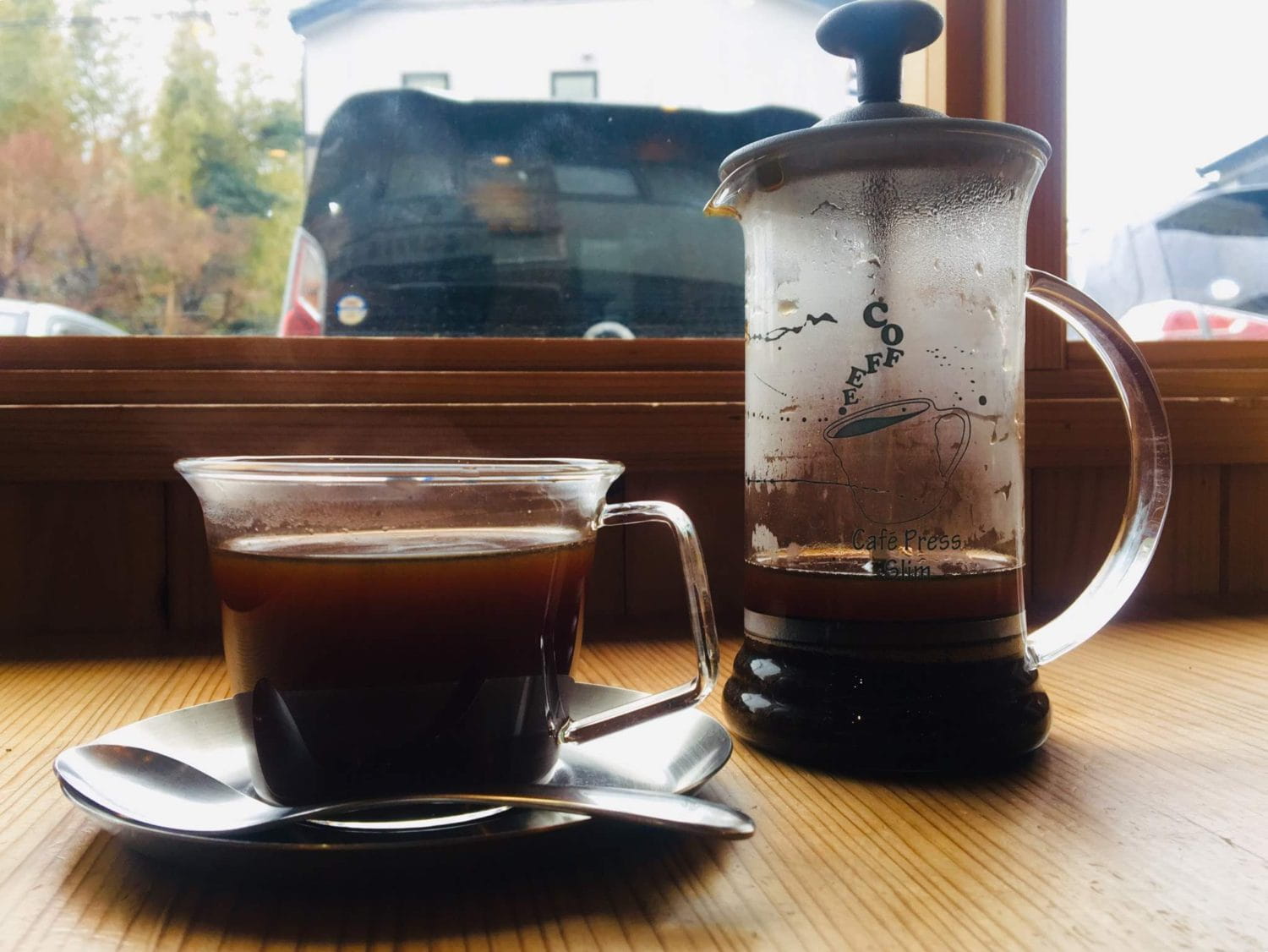
The particle size is about 1 to 1.8 mm, comparable to "rock sugar."

The examples provided are just guidelines, so actually brew it and see if it extracts deliciously. If the taste is too strong, try a slightly coarser grind; if it tastes weak, try a slightly finer grind.
Importance and Concept of Grind Size
The "grind size" is almost always mentioned in coffee equipment introductions and brewing classes, but why is it given so much importance?
It's because the grind size affects the concentration of the extracted coffee.
What does that mean? Imagine this experiment!

If you put coffee grounds of different grind sizes into separate cups, immerse them in hot water for the same amount of time, and leave them there...
Between the cup with finely ground coffee and the cup with coarsely ground coffee, which cup would have a higher concentration of coffee components dissolved in it?
The answer is, of course, the finely ground coffee.
The larger the surface area of the coffee grounds that comes into contact with water, the more coffee components will dissolve.
The finer the grind, the more easily the components are extracted.
Next, let's consider the contact time between coffee and hot water for each brewing method.
For paper drip, where hot water is poured over the coffee to extract it, the contact time between the grounds and the hot water, from pouring until the water passes through the filter, is only a few seconds.

In contrast, for a French press, where coffee grounds are steeped in hot water and then the filter is pressed down, the contact time between the hot water and coffee is 3 to 4 minutes.

These two brewing methods have different contact times between the grounds and hot water.
To achieve just the right concentration of coffee for both, what should the grind size be?
Here's a quick recap of the key point: "The finer the grind, the more components are extracted."
Therefore, for paper drip, which has only a few seconds of contact, you should grind the coffee a little finer to extract as much as possible in that short time. For French press, which has 3 minutes of contact, you should grind a little coarser to prevent over-extraction.
You might sometimes wonder what grind size to use for different brewing equipment, but it's helpful to remember: if the extraction time (the time coffee and hot water are in contact) is short, grind finely; if it's long, grind coarsely!
Once you get used to it, you'll probably be able to tell if the grind size is appropriate just by looking. However, ultimately, personal preference is what matters most! Make fine adjustments and find the grind size that tastes best to you!